Fire retardant fabric is only as reliable as the testing behind it. Whether you are inspecting incoming material, verifying a supplier’s claims, or simply want to confirm a tarp or curtain in your facility still performs as expected, knowing how to test if fabric is flame retardant is essential before you trust it to protect people and equipment. In this guide, we walk through both simple hands-on checks and the official laboratory test methods used to certify fire retardant fabric, so you can evaluate materials with confidence.

As a Shenzhen-based manufacturer and exporter specializing in fireproof and waterproof technical textiles, we test every roll of fire retardant fabric used in our fire-retardant tarps, machine covers, protective curtains, and insulation mats against ASTM and NFPA standards before it ships. This guide reflects the same testing knowledge our quality control team applies every day.
Table of Contents
- Why Testing Fire Retardant Fabric Matters
- How to Test If Fabric Is Flame Retardant?
- Simple, At-Home Flame Tests
- Official Laboratory Test Methods
- Step-by-Step: Performing a Basic Vertical Flame Test
- How to Read and Interpret Test Results
- Comparison Table: Fire Retardant Fabric Test Methods
- Common Mistakes When Testing Fire Retardant Fabric
- When Should Fire Retardant Fabric Be Retested?
- Common Applications Where Testing Is Critical
- How to Choose a Fire Retardant Fabric Supplier With Verified Testing
- FAQ: Testing Fire Retardant Fabric
Why Testing Fire Retardant Fabric Matters
Not every fabric marketed as “flame resistant” or “fire retardant” actually performs as claimed. Flame retardant treatments can degrade with washing, UV exposure, and abrasion, and some low-cost suppliers may not test their products against recognized standards at all. Testing fire retardant fabric — whether through a quick field check or a full laboratory evaluation — is the only reliable way to confirm that a material will behave safely if it is ever exposed to flame in a real industrial or construction environment.
How to Test If Fabric Is Flame Retardant?
There are two general approaches to testing fire retardant fabric, and the right one depends on how much certainty you need:
- Simple field or at-home tests — quick, low-cost checks that can indicate whether a fabric shows basic flame retardant behavior, useful for spot-checking or preliminary screening.
- Certified laboratory test methods — standardized procedures (such as ASTM and NFPA protocols) performed under controlled conditions, producing measurable, repeatable results that can be used for compliance, certification, and procurement decisions.
For any application where safety compliance, insurance requirements, or building codes are involved, laboratory testing against a recognized standard is the only method that should be relied upon. Simple field tests are useful for quick verification but are not a substitute for certified test reports.
Simple, At-Home Flame Tests
While not a substitute for certified testing, these basic checks can help you get a quick initial read on a fabric sample:
1. The Match or Lighter Test
Hold a small fabric swatch with tongs or pliers (never bare hands) over a non-flammable surface, and briefly apply a small flame (such as a lighter) to the edge of the fabric for a few seconds, then remove the flame source. Observe:
- Does the fabric ignite immediately, or does it resist catching fire?
- Does it continue burning after the flame is removed, or does it self-extinguish?
- Does it melt and drip, or does it char in place?
A fabric that resists ignition, self-extinguishes quickly, and chars rather than melts is showing basic flame retardant behavior. A fabric that ignites easily and continues burning after the flame source is removed is likely not flame retardant.
2. The Burn Residue and Smell Test
Natural cellulose fibers (cotton, linen) typically produce a paper-like ash and smell similar to burning paper. Synthetic fibers often melt and produce a plastic-like odor. Flame retardant treated fabric frequently produces a distinct char residue and a different chemical smell due to the flame retardant compound reacting with heat — a useful (though not definitive) clue during preliminary screening.
3. Basic Char Length Observation
After a brief, controlled flame exposure, measure how far the burned or charred area extends from the point of contact. Fire retardant fabric should generally show a limited, localized char area rather than an extensive burned or melted zone spreading across the sample.
Important safety note: Always perform any flame testing on small swatches, in a well-ventilated area, away from flammable materials, with a fire extinguisher or water nearby, and never on a finished product still in service.
Official Laboratory Test Methods
For verified, standardized results, fire retardant fabric should be tested using recognized industry protocols. The most common methods include:
ASTM D6413 — Vertical Flame Test
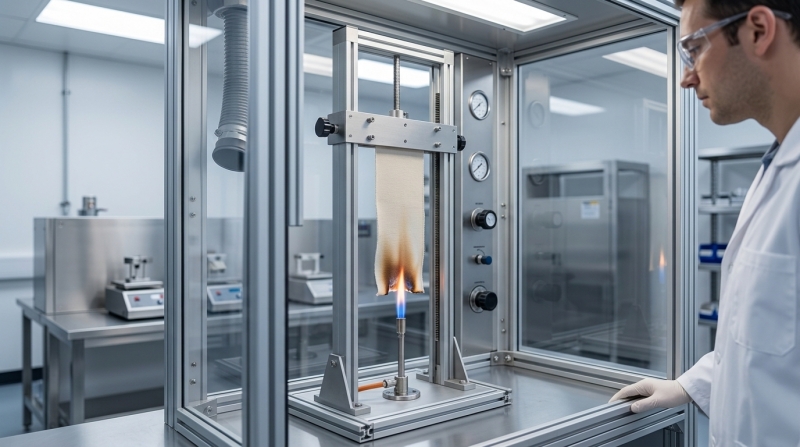
This test measures a fabric’s flame resistance by mounting a sample vertically, applying a controlled flame for a specified time, then measuring char length, afterflame time (how long the fabric continues burning after the flame is removed), and afterglow time (how long it continues glowing without visible flame).
ASTM E84 — Surface Burning Characteristics
This test evaluates flame spread and smoke development across a material’s surface, commonly used for construction and building material applications, including some technical textiles used in interior or semi-enclosed environments.
NFPA 701 — Flame Propagation of Textiles and Films
Widely used for tarps, curtains, and drapery-type fabrics, this standard method tests flame propagation under controlled exposure and is one of the most commonly referenced standards for the type of fire retardant fabric used in tarps and protective curtains.
ISO Flammability Standards
For international buyers, ISO test methods (such as ISO 6941 for vertical flame spread) may also be referenced, particularly for products sold into markets that follow ISO-based regulatory frameworks rather than ASTM/NFPA alone.
Step-by-Step: Performing a Basic Vertical Flame Test
While full laboratory testing requires specialized equipment, understanding the basic procedure helps buyers interpret test reports and evaluate supplier claims:
- Prepare the sample: Cut a fabric swatch to the standard test size specified by the method being used (dimensions vary by standard).
- Mount vertically: Secure the sample in a vertical test frame or holder, ensuring it hangs freely without contact with other surfaces.
- Apply the flame: Expose the bottom edge of the fabric to a controlled flame source for the specified duration (commonly a set number of seconds per the standard).
- Remove the flame and start timing: Record the afterflame time (how long the fabric continues to burn after the flame source is removed).
- Record afterglow time: Note how long any glowing (without visible flame) continues after the flame itself has stopped.
- Measure char length: Once the sample has cooled, measure the length of the charred or damaged area from the point of flame contact.
- Compare to standard limits: Check the measured char length, afterflame time, and afterglow time against the maximum limits defined by the specific standard (such as ASTM D6413 or NFPA 701) to determine pass/fail.
How to Read and Interpret Test Results
When reviewing a fire retardant fabric test report, focus on these key metrics:
- Char length — shorter char length indicates better flame resistance; standards specify a maximum allowable length.
- Afterflame time — the fabric should stop burning quickly once the flame source is removed; longer afterflame times indicate weaker flame retardant performance.
- Afterglow time — similar to afterflame, shorter is better, indicating the material does not continue smoldering.
- Melting or dripping behavior — many standards note whether the fabric melts or drips flaming material, which is considered a failure condition in most test protocols due to the burn risk it creates.
A passing result means the fabric met the specific standard’s requirements — but always confirm which standard was used, since a fabric can pass one test method while not being evaluated against another that may be more relevant to your application.
Comparison Table: Fire Retardant Fabric Test Methods
| Test Method | What It Measures | Common Use Case | Testing Environment |
|---|---|---|---|
| Match/Lighter Field Test | Basic ignition resistance, self-extinguishing behavior | Quick preliminary screening | Field/informal, small swatch |
| ASTM D6413 (Vertical Flame Test) | Char length, afterflame time, afterglow time | General industrial and protective textiles | Certified laboratory |
| ASTM E84 | Flame spread, smoke development | Construction/building material textiles | Certified laboratory |
| NFPA 701 | Flame propagation of textiles and films | Tarps, curtains, drapery-type fabric | Certified laboratory |
| ISO 6941 | Vertical flame spread | International/export market compliance | Certified laboratory |
Common Mistakes When Testing Fire Retardant Fabric
- Testing on a used or aged fabric sample and assuming the result reflects a new product’s performance.
- Confusing a field test result with certified performance — a swatch that self-extinguishes in a quick lighter test is not a substitute for a laboratory-issued test report.
- Not checking which standard was used — a product tested only to one standard may not meet the requirements of a different standard relevant to your project or region.
- Ignoring coating or lamination effects — testing only the base fabric rather than the finished, coated product can give misleading results, since coatings affect flame behavior.
- Skipping retesting after significant wear — assuming original test results still apply after years of outdoor exposure, washing, or heavy use.
When Should Fire Retardant Fabric Be Retested?
For ongoing industrial use, consider retesting or requesting updated certification in these situations:
- After extended outdoor exposure (commonly every 1–3 years for tarps and covers)
- After heavy washing, cleaning, or chemical exposure
- When switching suppliers or fabric batches for a safety-critical application
- When required by insurance, building code, or client compliance documentation
Common Applications Where Testing Is Critical
Verified flame testing is especially important for:
- Fire-retardant tarps covering machinery, construction materials, and flammable stock
- Welding curtains and screens used near active spark sources
- Protective machine covers for CNC equipment, generators, and outdoor tools
- Insulation mats and blankets used around heat-generating equipment
- Construction site enclosures and containment barriers subject to code compliance
How to Choose a Fire Retardant Fabric Supplier With Verified Testing
When sourcing fire retardant fabric, confirm your supplier’s testing practices by checking for:
- Third-party or in-house lab test reports referencing ASTM, NFPA, or ISO standards specific to the finished product.
- Batch-level testing consistency rather than a single historical certificate covering all production.
- Willingness to share documentation before purchase, not just after a complaint or issue arises.
- Testing on the coated, finished product — not only the raw base fabric before treatment or lamination.
- OEM/ODM support for custom testing requirements specific to your project or region.
FAQ: Testing Fire Retardant Fabric
Can I test if fabric is flame retardant at home?
Yes, a basic lighter or match test on a small swatch can give a preliminary indication — checking ignition resistance, self-extinguishing behavior, and char pattern — but this is not a substitute for certified laboratory testing for safety-critical applications.
What is the most common test for fire retardant tarps and curtains?
NFPA 701 is one of the most widely used standards for tarps, curtains, and drapery-type textiles, evaluating flame propagation under controlled test conditions.
How do I know if a fabric’s flame retardant test report is legitimate?
Check that the report references a specific recognized standard (such as ASTM D6413, ASTM E84, or NFPA 701), includes measured results (char length, afterflame, afterglow) rather than a vague pass/fail statement, and was issued by a qualified testing lab.
Does passing a flame test mean the fabric is fireproof?
No. Passing a flame test confirms the fabric meets specific performance limits under controlled test conditions — it does not mean the fabric is immune to fire under all real-world conditions.
How often should fire retardant fabric be retested?
For outdoor industrial products, many buyers retest or request updated certification every 1–3 years, or sooner if the fabric has experienced heavy wear, washing, or chemical exposure.
Need Verified, Tested Fire Retardant Fabric?
At Xintex, every roll of fire-retardant tarp, machine cover, protective curtain, and insulation mat fabric we produce is tested to meet ASTM and NFPA standards, with documentation available for every order. As a Shenzhen-based factory, we support OEM/ODM projects and can provide batch-specific test reports so you know exactly what protection you’re getting.
Contact us today for a fire retardant fabric quote, sample request, or test report — and let’s build a safer, more verifiable supply solution together.