When sourcing heavy‑duty protective textiles, industrial buyers frequently come across vinyl laminate, vinyl‑coated fabric and PU‑coated polyester. All three can be formulated to meet NFPA 701‑2 fire‑retardant certification, yet they are built differently and serve distinct field scenarios. There is no universal “better” option — the right choice depends on your project’s mechanical load, weight requirement, outdoor exposure and fabrication method.
Construction Overview
Vinyl Laminate
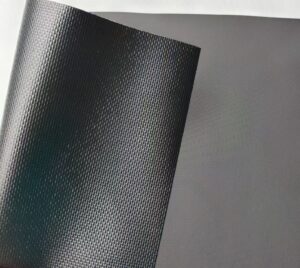
A woven polyester scrim core sits in the middle. Solid PVC vinyl films are thermally laminated onto both sides of the base fabric. The lamination process bonds film layers mechanically to the scrim, rather than painting liquid compound onto textile surface. Common weight: 14 oz per square yard for heavy industrial covers.
**Vinyl‑Coated Fabric**
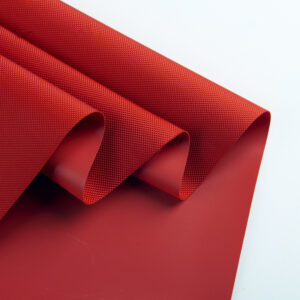
Liquid PVC compound is applied onto one or both sides of polyester base fabric. Base denier can vary, including 500D, 800D and 1000D polyester. Flame‑retardant additives are mixed into the coating layer to achieve NFPA 701‑2 compliance.
**PU‑Coated Polyester Fabric**
Polyurethane liquid coating is applied to polyester woven substrate (200D / 400D / 1000D grades available). Fire‑retardant additives are incorporated within the PU coating system to pass NFPA 701‑2 test requirements. Typically much lighter than PVC‑based materials.
Side‑by‑Side Performance Comparison
1. Waterproof performance**
– Vinyl Laminate: Excellent. Continuous solid vinyl film barrier delivers stable waterproof performance.
– Vinyl‑Coated: Excellent. Full PVC coating provides reliable water resistance.
– PU‑Coated Polyester: Good waterproof capability; performance is subject to coating integrity.
2. Fire‑retardant capability
All three material systems can be certified to NFPA 701‑Test Method 2 with proper formulation.
– Vinyl Laminate: FR additives embedded within vinyl film layers.
– Vinyl‑Coated: FR compound mixed into PVC coating.
– PU‑Coated Polyester: FR additives blended into PU coating layer (available across 200D‑1000D substrate options).
3. Weight & portability**
– Vinyl Laminate: Heavier and stiffer; high dimensional stability.
– Vinyl‑Coated: Medium weight; stiffness varies with coating thickness.
– PU‑Coated Polyester: Significantly lighter and more flexible, preferred for applications prioritizing low‑weight handling.
4. Mechanical & peel behaviour
– Vinyl Laminate: High peel resistance between film and scrim; holds up well under repeated stretching, wind load and temperature cycling. Well‑suited for frequent sewing, pocket fabrication and long‑term fixed‑installation covers.
– Vinyl‑Coated: Good overall durability; peel performance depends on coating formula and production process.
– PU‑Coated Polyester: High flexibility; more sensitive to sharp abrasion compared with PVC‑based textiles.
5. Fabrication characteristics**
– Vinyl Laminate: Compatible with sewing, heat‑welding, magnet pockets, straps and screen printing. Stiffer hand feel.
– Vinyl‑Coated: Supports sewing and heat‑welding.
– PU‑Coated Polyester: Easy to sew; generally not suitable for high‑temperature heat‑welding.
Choose Vinyl Laminate when you have these project conditions:**
– Heavy‑duty permanent / semi‑permanent outdoor protective covers
– Insulated cover systems (paired with mesh layers to build air pockets)
– Frequent mechanical stress, wind vibration
– Projects requiring consistent thickness and high peel performance
Choose Vinyl‑Coated Fabric for:
– Mid‑strength tarps, temporary site protection
– Cost‑conscious projects that still require PVC‑level weather resistance
– NFPA 701‑2 certified general‑purpose industrial enclosures
Choose PU‑Coated Polyester (200D / 400D / 1000D) when:
– Weight reduction and easy manual handling are top priorities
– Portable, foldable protective gear
– You need NFPA 701‑2 certification while avoiding heavy PVC material
Closing
Each material has its valid place in industrial protection. We supply all three material families in custom colours, dimensions and finished‑goods processing. If you share your field environment, weight limits and certification requirements, we can match the correct textile for your use‑case.