Fire Retardant Fabric Solutions
High-performance fire retardant fabrics engineered for environments where safety, durability, and compliance are critical.
At Shenzhen Xingtex New Material Co., Ltd, we provide customized flame-resistant textile solutions designed for industrial protection, outdoor applications, and safety-critical environments.
What Makes a Fabric Fire Retardant?
Fire retardant fabrics are designed to slow ignition, reduce flame spread, and minimize heat release.
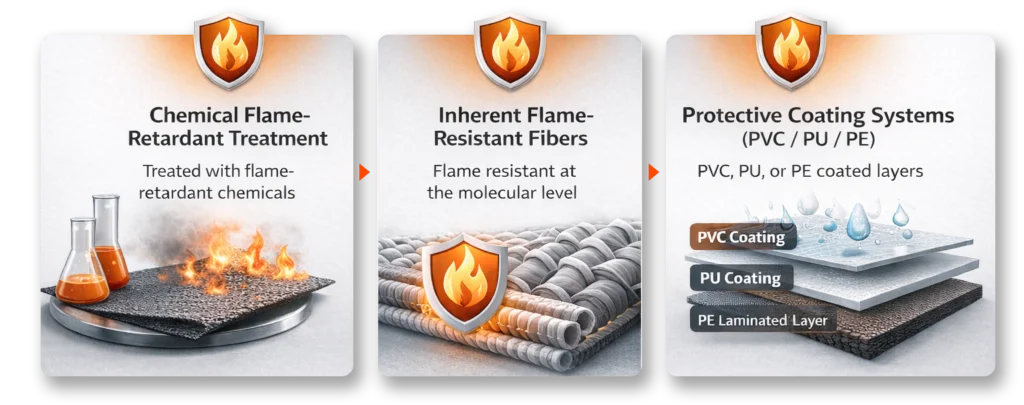
This is achieved through:
Chemical flame-retardant treatment
Inherent flame-resistant fibers
Protective coating systems (PVC, PU, PE)
 These materials are not “fireproof,” but they are engineered to control fire behavior and improve safety performance.
Fire Retardant Standards & Compliance
Our materials can be developed to meet international standards:
NFPA 701 (USA – flame propagation)
EN 13501-1 (EU – fire classification)
BS 5867 (UK – textile fire resistance)
DIN 4102 (Germany – building materials)
Certification depends on material structure, coating, and application requirements.
Material Structures & Options
We offer flexible construction options:
Base Fabrics
- Polyester
- Oxford fabric
- High-tenacity woven fabrics
Coating Options
- PVC coated flame-retardant fabric
- PU coated fabric
- PE laminated fabric
Additional Functions
- Waterproof
- UV resistance
- Anti-mildew
- Tear resistance
Performance Characteristics
Typical performance includes:
Flame spread resistance
Self-extinguishing capability
Thermal insulation
Low smoke emission
Structural stability under heat
Performance varies based on fabric weight, coating thickness, and use environment.
Manufacturing Process
Our controlled production process ensures consistency:
Yarn preparation
Fabric weaving
Flame-retardant treatment or coating
Drying & curing
Final inspection and packaging
- Stable batch production
- Industrial-grade quality control
- Export-ready standards
Quality Control & Testing
We implement strict testing procedures:
Flame resistance testing
Tensile and tear strength testing
Coating adhesion testing
Waterproof performance testing
Test reports and certifications available upon request.
Understanding Fire Retardant Fabrics
What is Inherent Flame Retardant Fabric (IFR)?
Inherent flame retardant fabric (IFR) is made from fibers that are naturally flame-resistant at the molecular level.
Even after repeated washing and long-term use, IFR fabrics maintain their performance. They:
Slow down burning
Self-extinguish after flame removal
Produce less smoke
Flame Retardant vs Flame Resistant vs Fire Retardant vs Fire Resistant
Flame Retardant Fabric
Chemically treated to slow flame spread (small-scale flame testing).
Fire Retardant Fabric
Used in broader contexts with larger fire simulation testing.
Flame Resistant / Fire Resistant Fabric
Made from inherently resistant fibers that resist ignition.
Flammable vs Flame Retardant vs Fireproof Fabric
Flammable Fabric
Ignites easily and burns rapidly.
Flame Retardant Fabric
Slows burning and reduces fire spread.
Fireproof Fabric
A general term for highly fire-resistant materials (not completely non-burnable in extreme conditions).
Application Scenarios
Our fire retardant fabrics are widely used in:
Industrial covers and tarps
Welding blankets
Outdoor tents and shelters
Transportation protection materials
Oil & gas environments
Designed for both safety compliance and durability.
Why Choose XT New Materials
In-house production lines
Flexible customization capabilities
Fast sampling (7–10 days)
Stable large-scale production
Experience in global B2B markets
Request a Custom Solution
Frequently Asked Questions (FAQ)
- What is the difference between flame retardant and fire resistant fabric?
Flame retardant fabrics are usually chemically treated to slow fire spread, while flame resistant fabrics are made from inherently non-flammable fibers.
- Is fire retardant fabric the same as fireproof fabric?
No. Fire retardant fabrics reduce flammability and slow combustion, but most materials are not completely fireproof under extreme conditions.
- Does flame retardant fabric lose its performance after washing?
It depends on the type. Treated fabrics may lose effectiveness over time, while inherent flame retardant fabrics maintain permanent performance.
- Can fire retardant fabric also be waterproof?
Yes. Flame retardant fabrics can be combined with coatings such as PVC or PU to achieve both fire resistance and waterproof performance.
- What industries use fire retardant fabrics?
Common industries include construction, oil & gas, transportation, outdoor equipment, and industrial manufacturing.
- How do I choose the right fire retardant fabric?
You should consider application environment, required standards, durability, and whether additional features like waterproofing are needed.

 24-hour response